Oct 26, 2026Buying Guides
Hair-Care Promotion Orders: Calculate Saleable Units Before Confirming Volume
Plan a hair-care promotion order using saleable units, retained samples, replacement stock and contribution margin rather than discount-driven volume guesses.
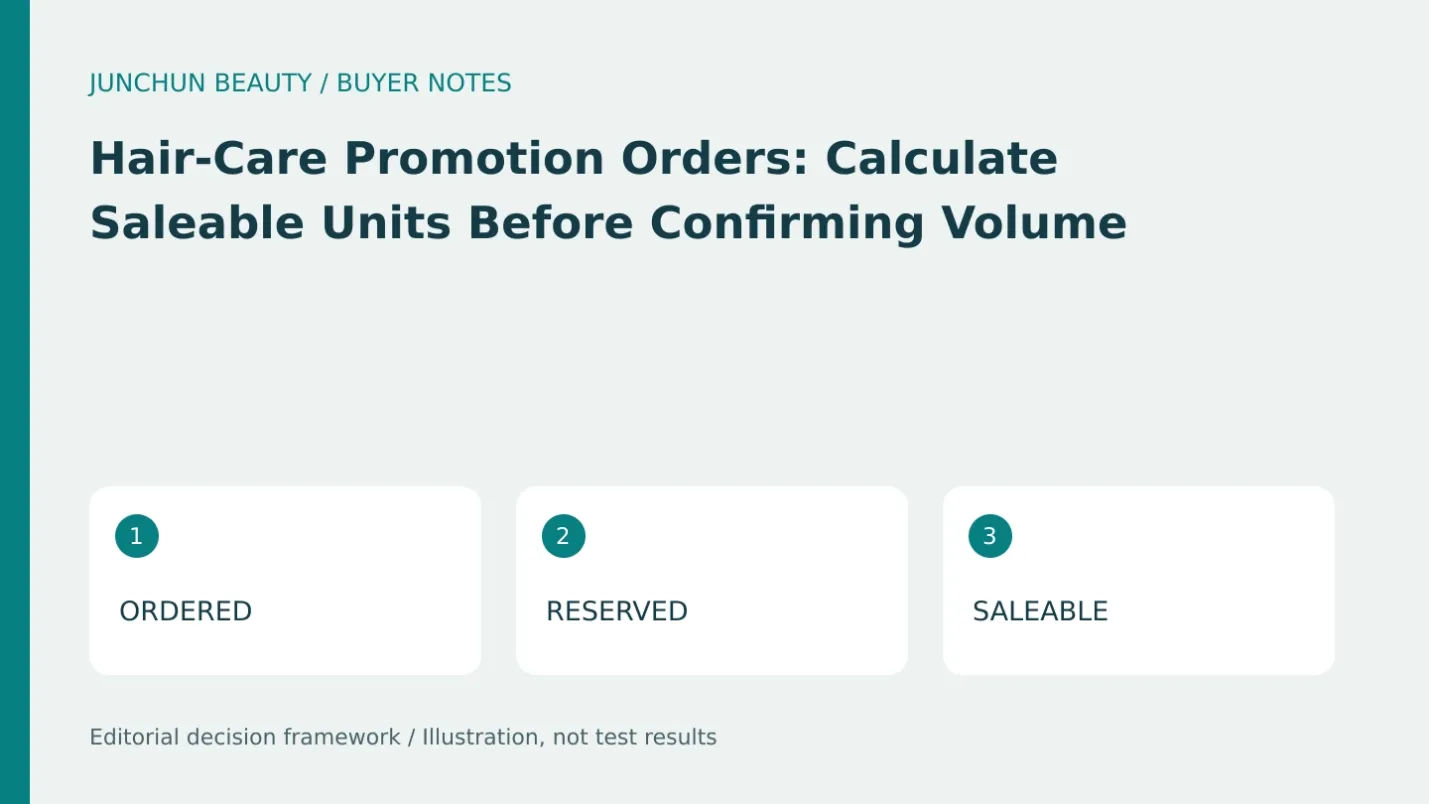
Base the order on realistic saleable units and contribution margin, not an assumed sales spike. Deduct testing, retained and replacement units, then check whether the remaining inventory can support the channel plan.
Use the promotion as a planning signal
Amazon's official calendar lists hair care for 29–30 October and personal care for 31 October–1 November. These dates are useful context for existing inventory. They do not establish a feasible production or export deadline for a new OEM project. Confirm formula, packaging, artwork, testing and logistics before promising availability.
Calculate the inventory you can actually sell
For an illustrative 500-unit order, reserving 10 units for retention, 20 for controlled trials and 20 for replacements leaves 450 saleable units. The allocations are a hypothetical planning model, not a JunChun policy or a forecast. Add each channel's own damaged-stock and returns assumptions. Do not count the same units as both sale stock and sampling stock.
Calculate contribution on the same basis
Use net revenue after promotion and fees, then subtract landed product cost, variable fulfillment and expected return or replacement cost. Keep advertising assumptions explicit. A lower ex-factory price can still produce a worse result if a fragile pack increases leakage or a heavier bottle increases freight. Compare alternatives on cost per saleable unit and cash required before the launch.
Approve the packaging in the distribution route
Test closure security, leakage and label durability with the approved formula and intended shipping configuration. Determine how the buyer will log failures and identify the batch. A laboratory bottle is not the retail pack. A packaging substitution after sample approval should trigger a compatibility review rather than being treated as an invisible procurement shortcut.
Set the reorder trigger before discounting
Agree a stock-cover target, reorder lead-time assumption, maximum return rate and minimum contribution. Review actual sales and complaints after the event. JunChun can discuss existing hair-care formulas and packaging routes, but availability and project timing require confirmation. The strongest next order answers what sold, what failed and what changed; it does not repeat the previous quantity automatically.
Buyer FAQ
Should we order more because an event is near?
Only if stock, cash, evidence and realistic replenishment timing support it.
Are the 500-unit allocations mandatory?
No. They are an illustrative calculation to adapt to the buyer’s channel.
Does lower MOQ remove inventory risk?
No. It reduces quantity exposure but does not remove weak positioning or margin problems.
Related products and project review
Selected mature formulas with compatible in-stock packaging may start at 100 pcs per SKU. Packaging changes start at 500 pcs per SKU, subject to the actual component and process. Send your market, product requirement, quantity and packaging preference to info@junchunbeauty.com for samples and a project-specific quote.
Compare leave-in formats: https://www.junchunbeauty.com/products/private-label-multi-benefit-leave-in-conditioner
Sources
Amazon; updated 19 October 2026: https://www.aboutamazon.com/news/retail/amazon-holiday-beauty-event-2026